Impact Storytelling for Nonprofits: Stories That Move People to Act.
Learn how to tell impact stories that move donors to act. Hero arcs, ethical guidelines, before/after formats, and multimedia storytelling for NGOs.
Your impact report is accurate. Your statistics are real. Your mission matters.
So why aren't more people donating?
In most cases, the answer isn't your cause. It's your communication. Nonprofits default to scope-of-need framing: millions affected, billions needed, decades of injustice. But research consistently shows that the larger the number, the smaller the response. Donors don't give to statistics. They give to people.
This guide teaches you the craft of impact storytelling for nonprofits: the narrative frameworks, ethical guidelines, production formats, and distribution strategies that turn a good cause into a compelling story that moves people to act.
TL;DR
One named beneficiary in a clear hero-problem-solution arc outperforms statistics-led appeals in nearly every controlled study and real-world campaign
Ethical storytelling (dignity, informed consent, community voice) isn't a constraint on effectiveness. It IS the effectiveness strategy for 2026 and beyond
The tools to produce professional-quality impact stories are now free or near-free for nonprofits: Canva Pro, Google Ad Grants ($10,000/month), Descript, and more
Why One Story Beats a Million Statistics
Here is the most counterintuitive finding in fundraising science.
When researchers Deborah Small, George Loewenstein, and Paul Slovic ran a controlled study in 2007, they gave participants two appeals. The first described Rokia: a 7-year-old girl from Mali, facing starvation. The second presented statistics about millions of food-insecure children across six African nations.
Participants given Rokia's story donated an average of $2.38. Participants shown the statistics donated $1.14. Then the researchers combined both: Rokia's story plus the statistical context. Donations dropped. Adding the data to the human story actively reduced giving.
This is the identifiable victim effect, and it is not a quirk. It is the operating system of human generosity.
Psychologist Paul Slovic calls the failure mode "psychic numbing." Compassion does not scale with the number of people in need. It peaks at one and actively fades as the number rises. In follow-up studies, subjects who read about two children in need gave less than subjects who read about either child alone.
The implication for your nonprofit's communications is direct: lead with one named person, in a specific place, facing a specific problem, with a specific resolution. That is not a stylistic preference. It is the most evidence-based thing you can do with a donor appeal.
Narrative transportation theory, developed by Melanie Green and Tim Brock in 2000, explains the mechanism. When readers are absorbed in a story, counterarguing drops, emotional involvement rises, and beliefs formed inside the story persist into real-world judgments. A 2013 study published in PLoS ONE found that character-driven stories with emotional content produce better understanding and stronger recall weeks later. Your donor doesn't just give because they felt something in the moment. They remember why they gave.
The sector-wide data supports this at scale. According to Giving USA 2025, total US charitable giving reached a record $592.5 billion in 2024. But the Fundraising Effectiveness Project's Q4 2024 data shows donor counts fell 4.5%, the fourth consecutive annual decline, with first-time donor retention at an all-time low. Fewer donors are giving more dollars. The organizations retaining those donors are the ones telling stories worth holding.
The Hero-Problem-Solution Arc: Your Beneficiary Is the Hero
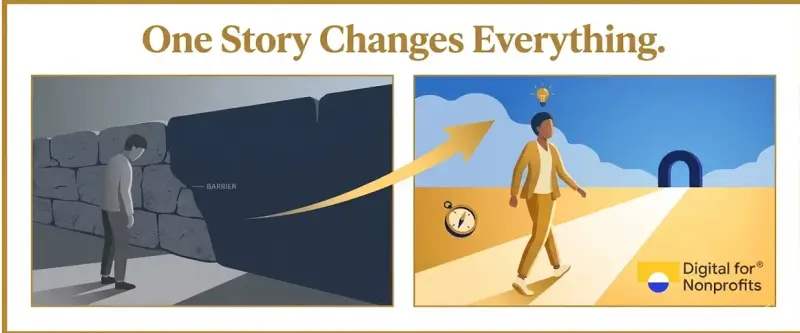
The single most common structural mistake in nonprofit communications is making the organization the hero. Donald Miller's StoryBrand framework states this principle directly: your nonprofit is not the protagonist of your story; your donor is.
The moment your appeal becomes "we came, we helped, we won," your audience's subconscious response is: "Great. They seem to have it handled." There is no role left for the donor.
The correct frame is different. Your organization is the guide that provides the empathy and authority to help the hero succeed. Your donor is the hero who steps in to solve the problem, and the beneficiary represents the stakes, the person whose life is changed by the hero’s action.
The arc has seven beats:
A character (your beneficiary) wants something specific and urgent
A problem stands in the way, with external, internal, and philosophical dimensions
A guide (your organization) enters with empathy and a credible track record
A plan is offered: this is what your donation makes possible
A call to action is made clear
The stakes are named: what happens if nothing changes
Success: the transformation is shown, concretely and specifically
Harvard Kennedy School lecturer Marshall Ganz, whose Public Narrative framework trained thousands of Obama campaign volunteers in 2008, articulates this as three nested stories. The Story of Self establishes the values that called someone to act. The Story of Us names the shared values of a community mobilized together. The Story of Now delivers the urgent challenge demanding immediate action. Apply this to any beneficiary appeal and you have a structure that works in a 300-word email, a 90-second video, or a direct-mail letter.
Real Organizations, Real Results
The organizations that have built the largest fundraising machines in the sector have done so through consistently applied donor-as-hero storytelling.
Charity:Water has raisedover $1 billion and brought clean water toover 21 million people across 29 countries. Its single most powerful campaign was the story of Rachel Beckwith, a 9-year-old who asked for $9 donations for her birthday instead of gifts. After her tragic death, her campaign raised $1.27 million from nearly 32,000 donors, funding projects for 37,770 people in Ethiopia. Rachel became the community's heroic archetype, a donor whose simple act changed thousands of lives.
Pencils of Promise (PoP) traces its origin to a single boy in India who told founder Adam Braun that the one thing he wanted was "a pencil." This child represents the "stakes" in every PoP keynote, while the donor is invited to be the hero who provides the solution. The organization has since builtover 600 schools across Ghana, Guatemala, and Laos.
To Write Love On Her Arms (TWLOHA) began as a MySpace post about 19-year-old Renee Yohe. By positioning a community of supporters as the heroes capable of saving a life, initial T-shirt sales raised $13,000 for her care. The organization has since channeled more than $4.3 million into mental health support and funded over 31,000 hours of therapy.
The structure works because it respects how humans actually make decisions: emotionally first, rationally after. Your job is to give the emotion somewhere to go by inviting the donor to play the lead role in the story.
A Beneficiary Story Framework You Can Use This Quarter
Understanding story structure is only half the battle; the real challenge is building a system to collect and publish those stories consistently. Here are five frameworks to help you build that scaffolding:
The Adaptable Five-Part Structure: Vanessa Chase Lockshin’s model from The Storytelling Non-Profit is ideal for day-to-day production. By mapping Connection, Character, Conflict, Resolution, and Donor's Role to specific paragraphs, organizations like Girl Scouts USA and Meals on Wheels have successfully systematized their storytelling pipelines across emails and social media.
The Pixar "Story Spine": This acts as a simple litmus test for narrative depth. Use the fill-in-the-blank prompt: "Once upon a time there was ___. Every day ___. One day ___. Because of that ___. Until finally ___." If you can't complete this for your beneficiary, you have a description, not a story.
The Public Narrative (Self, Us, Now): Developed by Marshall Ganz, this framework is your best bet for campaign launches and advocacy. It shifts the focus from simply donating to active mobilization.
The "Most Significant Change" (MSC) Technique: Created by Rick Davies and Jess Dart, this turns story collection into a program discipline. By asking field staff and beneficiaries one open question, "What was the most significant change, and why?", you create a verified, community-validated story pool that reduces ethical and accuracy risks.
The Before-and-After Arc: This remains the most reliable structure for direct-response fundraising. A classic example is Heifer International’s story of Beatrice Biira, whose journey from receiving a goat to graduating college has anchored their communications for 25 years by highlighting a clear, measurable gap.
Pro Tip on Visuals: While the "After" photo feels like the natural conclusion, Smile Train, which has supported 2 million surgeries, found that appeals featuring only "Before" photos often raise significantly more. Don't assume the transformation arc will always win; sometimes the unresolved tension of the problem is a more powerful motivator for donors.
How to Conduct a Beneficiary Interview
The story does not write itself. It requires an interview that draws out scene-based, specific details. These techniques work across language and cultural differences:
Start with light conversation. Let the narrator choose the location, the interviewer, and who is in the room. Begin with easy, present-tense questions before moving into memory. Use StoryCorps' free "Great Questions" list as your starting reference.
Ask sensory, scene-based questions: "Walk me through that morning. What did you see? Who was with you? What happened next?" Follow with the Most Significant Change prompt: "What was the most significant change in your life, and why does it matter to you?"
After every substantive answer, use one follow-up: "Can you tell me more about that?"
Share the draft back. Let the narrator review identifying details, correct anything inaccurate, and approve the final form. This step is non-negotiable per Bond, Dóchas, UNICEF, and Voice of Witness guidelines. It is also what turns a serviceable story into a great one: corrections and additions from the narrator are almost always more vivid and specific than what an outsider observes.
Ethical Storytelling: Dignity Is the Fundraising Advantage
The formalization of ethical storytelling standards since 2017 is the most important evolution in nonprofit communications in a generation.
The term "poverty porn" was coined by Danish aid worker Jorgen Lissner in 1981: content that exhibits human suffering without dignity, without consent, without the person's participation in how their image or story is used. It is extractive by design. And a growing body of evidence suggests it also backfires strategically: it trains donors to expect emotional manipulation, builds no long-term trust, and positions communities as permanent victims rather than agents of change.
Five frameworks now define the sector consensus on ethical storytelling.
Bond's "Putting the People in the Pictures First" (UK, updated November 2024) is signed by more than 70 international NGOs. Its core principle: informed consent is much more than form-filling. It is a meaningful dialogue process in which the narrator understands how their story will be used, who will see it, for how long, and how to withdraw consent. The 2024 update added explicit sections on AI-generated imagery, power and race, and content production in emergencies.
The Dóchas Code of Conduct (Ireland, 2007, updated 2023) establishes three governing principles: respect for dignity, belief in the equality of all people, and commitment to justice and solidarity.
UNICEF's Reporting Guidelines for Children apply a single practical test: "If this were my child, how would I want them portrayed?" No black bars across eyes, which criminalize rather than protect. No staging. No visible identification of children who are HIV-positive, survivors of sexual violence, or former child soldiers.
The IFRC Code of Conduct, signed by more than 600 organizations, requires NGOs to represent beneficiaries as "dignified human beings, not hopeless objects" and to show their capacities and aspirations, not just their vulnerabilities.
The Ethical Storytelling Pledge, founded by Rachel Goble of The Freedom Story, organizes 16 commitments around one principle: constituent first, donor second. Its sharpest requirement: "not telling the story, despite the resources invested, when it cannot be told with the integrity of this pledge."
When Ethical Failures Become Reputational Crises
The cost of ignoring these frameworks is no longer theoretical.
In 2019, Comic Relief faced widespread public condemnation when Labour MP David Lammy called out a celebrity Instagram post filmed in Uganda: "The world does not need any more white saviours. This just perpetuates tired and unhelpful stereotypes." Comic Relief's CEO subsequently committed to shifting away from celebrity-fronted films toward local storytellers and local voices.
In May 2023, Amnesty International Norway was forced to remove AI-generated images depicting Colombian police brutality after photojournalists noted warped faces, incorrect flag orientation, and anachronistic uniforms. Amnesty acknowledged it had no AI policy at the time of publication. The reputational damage was covered globally and immediately.
These failures share a single root cause: the organization prioritized its fundraising goal over the dignity and accuracy owed to the people represented.
Ethical Storytelling and Strong Fundraising Are Not Opposites
Mama Hope's "Stop the Pity, Unlock the Potential" campaign, launched in 2011, deliberately inverted poverty-porn tropes. Its "African Men, Hollywood Stereotypes" video has been viewed more than 20 million times. Founder Nyla Rodgers frames it simply: "Partnership instead of pity. Partnership includes seeing people as equals." Mama Hope has since reached more than 730,000 people across nine countries.
Charity: water's Tyler Riewer is explicit about the organization's storytelling philosophy: "For us, this is largely about focusing on hope rather than guilt." That choice has not limited their fundraising. It has defined their brand.
Dignity and emotional power are not opposites. What ethical storytelling rules out is emotional manipulation without the subject's participation. What it leaves in is everything that actually works.
Before-and-After Storytelling: Structure That Converts
The before-and-after arc is not a cliche. It is the most direct way to answer the donor's most important question: "Does my contribution actually change anything?"
The "before" state establishes the specific, concrete problem: not "children lack educational opportunity" but "Anita, 12, walked 6 kilometers each way to the nearest school, arriving too tired to focus, and dropped out in fifth grade."
The "after" state shows the specific, concrete transformation: "Eighteen months after the D4NP tech grant helped Anita's school launch an online learning platform, she passed her board exams with 87% marks and enrolled in a regional college prep program."
Between those two states sits your organization's role, your donor's contribution, and the verifiable mechanism of change.
Three production techniques sharpen the arc:
Use sensory, scene-based language in the "before." Readers need to feel the weight of the problem, not just understand it intellectually. What does the room look like? What time is it? Who else is present? What sounds, smells, textures define this moment?
Make the "after" concrete and verifiable. Vague transformation ("her life improved significantly") is worse than no transformation at all. Specific transformation ("she now runs a 12-person tailoring cooperative and trains three apprentices") is what donors remember and share.
Show the donor's role explicitly. The arc is not complete until you say: "Your $50 made this possible." Or, more specifically: "Your $50 covered the cost of six months of Google Workspace access for her cooperative." Tangible intervention details increase giving significantly, per Cryder, Loewenstein, and Scheines's "The Donor Is in the Details" (2013).
NextAfter's experiment library, built from more than 7,000 documented fundraising tests, confirms these principles at scale. Continuing a beneficiary story across an email and a matching landing page produced a 369% lift in click-through and a 121% lift in donation revenue in one documented test. Adding a beneficiary testimonial to a fundraising email lifted clicks to the donation page by 27.6%. Rewriting a vague mission-level ask into a specific initiative ask drove a 275% donation lift.
Blending Data with Narrative: The One-Number Rule
The Rokia experiment carries a warning that most nonprofit communicators miss: adding statistics to an emotional story reduced giving. This is not an argument against data. It is an instruction about sequencing.
Lead with one named person. Resolve their story with a specific, concrete intervention. Then introduce a single anchor data point about your organization's track record or the scale of change you have achieved. This sequence respects the emotional channel without abandoning the rational one.
Charity: water's 2017 storytelling case study in Fast Company pairs the personal story of Sanjita, who nearly lost her son to waterborne illness in Nepal, with a single verifiable number: diarrhea cases at the local clinic dropped from 6,433 in 2012 to 182 in 2016 after clean water arrived. One person. One number. One causal chain. That is the complete formula.
D4NP's State of Nonprofits Digitization Report 2025 provides anchor statistics that work precisely this way for any content about nonprofit digital capacity. 83% of Indian NGOs do not use available technology grants, forfeiting the equivalent of approximately $120,000 per year in free advertising.Only 17% of Indian nonprofits utilize free digital advertising grants.Only 13% offer multilingual digital resources. Each of these is a single sharp number that can open a story about one organization that changed its trajectory, making the individual story representative of a sector-wide pattern.
The operational discipline for data visualization in storytelling is simple. One anchor data point per slide or section. The title of any chart should be the takeaway sentence, not the label. One accent color for the number that matters. Everything else recedes.
Datawrapper is free and used by The New York Times and the United Nations. Flourish, acquired by Canva in 2022, offers a generous free tier including scrollytelling templates. Google Looker Studio is free for public dashboards. There is no budget constraint that justifies a wall of unstyled numbers.
Multimedia Storytelling: Where Stories Live in 2026
A story without distribution is a journal entry. The platform environment in 2026 has shifted decisively, and the data reshapes where nonprofits should invest.
Video: Format Has Shifted More Than Volume
Video remains the dominant medium, but "video" now means something different than it did in 2019. Wyzowl's State of Video Marketing 2025 reports that 91% of consumers say video quality affects brand trust. But 93% of marketers say user-generated content outperforms branded content, with UGC delivering roughly four times the click-through of traditional video ads.
The operational rule: polished, produced video for your website, donor cultivation, and Google Ad Grants campaigns; raw, native, vertical video for TikTok, Instagram Reels, and YouTube Shorts.
Optimal lengths by platform have stabilized. YouTube Shorts: 25 to 40 seconds. Instagram Reels: 15 to 30 seconds for maximum reach; reels longer than three minutes are not served to new audiences. TikTok: around 45 seconds. LinkedIn video: 60 to 90 seconds. The first three seconds of any video determine whether the algorithm serves it to new audiences. Captions are no longer optional: the majority of social video is watched on mute.
Photo Essays: Highest Emotional Density per Minute
The Everyday Africa project, founded in 2012 by Peter DiCampo and Austin Merrill via the Pulitzer Center, pioneered Instagram-first counter-narrative photojournalism. It has since spawned more than 100 "Everyday" projects globally. Its structure has become a template: establishing shot, then portraits, then detail shots, then a resolution image that shows agency, capability, and forward movement rather than victimhood. That structure works on Instagram, in annual reports, in grant applications, and on your website.
Audio: Highest Attention per Impression
Spotify for Podcasters is free. Descript starts at $16/month with text-based audio editing. Riverside.fm provides studio-quality remote recording for $15 to $29/month. Otter.ai gives 300 free transcription minutes per month. The tools exist. StoryCorps, which has recorded more than 645,000 participants since 2003 and is archived at the Library of Congress, demonstrates the model. Doctors Without Borders' "Everyday Emergency" podcast demonstrates the application for international NGOs.
Amplification: Google Ad Grants as Your Storytelling Distribution Engine
The most underused amplification tool in the sector is Google Ad Grants: $10,000 per month in free Google Search advertising, available to any verified nonprofit in one of 51 eligible countries.
M+R Benchmarks 2025 reports that search ads delivered the highest return of any nonprofit digital channel at $2.70 per $1 spent. But the average Ad Grant account uses approximately $300 of the available $10,000 per month. The gap between potential and utilization is the largest free-money opportunity in nonprofit marketing today.
Charity: water documented a 350% traffic lift, 300% new visitor lift, and 333% video-view lift in a single year of well-managed Ad Grants use. Those visitors arrived having searched for something specific. A well-structured storytelling campaign meets that search intent directly.
D4NP's research from the State of Nonprofits Digitization Report 2025 shows that 83% of Indian nonprofits do not use available digital grants. The pattern holds globally: eligible organizations do not apply, or they apply and leave most of the budget unspent. If your nonprofit is not activated on Google Ad Grants, D4NP can help you apply and build campaigns that use the full grant.
Free Tools Checklist for Nonprofit Multimedia Storytelling
AI and Impact Storytelling: The Lines That Matter
78% of nonprofits used generative AI in 2024, per M+R Benchmarks 2025. Only 42% had any AI policy or guidelines.
That gap is where reputational risk lives.
The defensible uses of AI in storytelling are well-established. Transcription of beneficiary interviews, using Otter.ai or OpenAI's Whisper. Translation of content into local languages, using DeepL or Google Translate. Editing audio and video by editing the transcript, using Descript. Drafting, repurposing, and tone adaptation for email, social, and web copy. Multilingual narration using tools like ElevenLabs. AI can accelerate every stage of the production pipeline without touching the story itself.
The indefensible uses are equally clear. AI-generated images of beneficiaries, presented without disclosure, are a fundamental breach of the ethical standards every major framework now requires. When Amnesty International Norway used Midjourney to generate images of Colombian protesters in 2023, it removed the only accountability mechanism that had historically constrained exploitation: a real person with a legal right to consent. Bond's 2024 ethical guidelines update is explicit: AI-generated images of beneficiaries must be clearly disclosed and should not manufacture emotional appeals that would otherwise require human subjects.
The principle is unchanged from 1981. The person in the picture matters. An AI-generated picture does not have a person in it. That is not a defense. It is the problem.
Use AI to work faster and more effectively. Keep human dignity at the center of every story.
Measuring What Moves People: Benchmarks for 2026
Measuring storytelling effectiveness is no longer optional. Kivi Leroux Miller's 2025 Nonprofit Communications Trends Report, drawn from 463 participants, identifies "inability to measure effectiveness" as the second-biggest challenge nonprofit comms teams face, behind time and budget.
M+R Benchmarks 2025, covering 2024 data from 216 nonprofit participants, provides the current baseline:
Email click-through rate on fundraising messages: 0.48%
Email-driven fundraising: $58 raised per 1,000 messages sent, down from $76 in 2023
Email now accounts for 11% of online revenue, down from 14% the prior year
Monthly giving grew 5% and now represents 31% of online revenue
First-time donor retention: 23%. Existing donor retention: 62%
TikTok follower counts grew 37% for nonprofits in 2024
Facebook fundraiser revenue fell 42% year-over-year
The Fundraising Effectiveness Project's Q4 2024 report adds the structural context: overall donor retention sits at 42.9%. Three percent of donors now generate 78% of dollars. The organizations that survive this concentration will be the ones that tell stories good enough to make a $100 donor feel like a co-hero of something real.
The metrics worth tracking for storytelling specifically:
Email open rate and click-through on story-led vs. data-led appeals (A/B testable in Mailchimp, Brevo, and most ESPs)
Donation page completion rate (M+R benchmark: 12%)
Average gift size on story-led vs. other campaigns
Social shares and saves on story content vs. other post types
New donor acquisition rate from storytelling-led campaigns
Year-two retention rate for donors acquired through story campaigns
That last metric is the most important one in 2026. Acquiring a donor is a cost. Retaining them is the return. The story you tell to acquire them is also the story that determines whether they give again. Donor stewardship is a storytelling function.
Your Next Impact Story: A Starting Checklist
Before you write the next beneficiary story, run through these eight questions:
Can you name one specific person this story is about?
What is the single most significant change in their life, in their own words?
What was the "before" state, in scene-based, sensory detail?
What was the specific intervention your organization provided?
What is the "after" state, expressed as a concrete, verifiable outcome?
Has the subject reviewed and approved this story in its final form?
What is the one anchor data point that makes this story representative?
What is the explicit action you are asking the donor to take?
If you can answer all eight, you have a story. If you cannot, you have a description.
The organizations winning the trust of donors in 2026 are not the ones with the biggest budgets or the most production polish. They are the ones with the most honest, specific, human stories, told with the dignity the people in those stories deserve.
That is a standard every nonprofit can meet. You already have the stories. You just need the system to collect and tell them.
Want help building that system using free tech grants and digital marketing tools? D4NP works with nonprofits globally to activate and maximize Google Ad Grants, build digital storytelling infrastructure, and develop content strategies grounded in self-reliance. Check your eligibility in five minutes with our free tech assessment.