Best Email Marketing Tools for Nonprofits in 2026
Compare the best free email marketing tools for nonprofits in 2026 and explore which fits your org size.
TL;DR
Sending donor emails from Gmail puts your account at risk of suspension, offers no unsubscribe management, and gives you zero analytics on donor engagement. A dedicated email marketing tool is not optional infrastructure: it is the baseline for any nonprofit serious about donor communication.
MailerLite gives 30% off paid plans, HubSpot gives 40% off, and Zoho gives $5,000 in wallet credits: genuine nonprofit programs that most NGOs never claim.
The right platform depends on your contact list size, team capacity, and whether you need a built-in CRM. This guide maps each tool to the org size it fits best.
Nonprofits are leaving a powerful channel underleveraged. Email generates between $36 and $42 for every $1 spent, and the average nonprofit email open rate of 28.59% outperforms the cross-industry average of roughly 21%. Yet only 68% of nonprofits use email marketing tools at all, and many of those are on the wrong plan, or the wrong platform entirely.
The tool landscape shifted significantly in the past two years. Mailchimp, long the default choice, cut its free plan from 2,000 contacts in 2022 to 500 contacts in 2025, and then to 250 contacts in early 2026. Brevo entered the nonprofit conversation with a 100,000 contact-free tier. MailerLite deepened its nonprofit discount to 30%. HubSpot extended a 40% reduction to qualifying organizations. For nonprofits evaluating their email setup, the question is no longer "should we use Mailchimp?" It is "which tool actually fits our size, our budget, and our mission?"
This guide compares six major platforms across free tiers, nonprofit discount programs, core features, and best fit by organization size. All pricing reflects current 2025 rates.
What Makes an Email Tool Right for a Nonprofit?
Before comparing platforms, it helps to know what you are actually evaluating. The features that matter most to nonprofits are different from those that matter to a retailer or SaaS company.
Contact and list management: Can the platform store all your donors, volunteers, and subscribers without charging you for contacts you have not emailed recently? Some platforms bill for every contact stored; others bill only for emails sent.
Automation: Can you send a welcome email automatically when someone joins your list? Can you trigger a re-engagement email when a donor lapses for 12 months? Automation turns a list into a relationship.
Segmentation: Can you separate major donors from first-time donors, or volunteers from newsletter readers? Segmented campaigns get click-through rates roughly 100% higher than non-segmented ones, according to Mailchimp's own research.
CRM integration: Most donation platforms (Donorbox, Classy, Kindful) connect to email tools via integration. Some platforms include a lightweight CRM. For small teams, an all-in-one solution saves hours each week.
Deliverability: A beautifully designed email that lands in spam is worthless. Reputable platforms maintain strong sender reputations and help you follow email compliance laws (CAN-SPAM, GDPR, DPDPA in India).
Nonprofit pricing: A 15% discount sounds modest. On a $500/month plan, it saves $900 a year. A 30% or 40% discount changes the calculation entirely. Always check whether the discount applies to the plan tier you actually need.
The Six Platforms, Compared
Mailchimp: The Familiar Name With a Shrinking Free Tier
Mailchimp is the most recognized name in email marketing. For years, its 2,000-contact free plan made it the default entry point for nonprofits. That advantage is gone.
Free plan: 500 contacts (reduced to 250 as of early 2026), 1,000 emails per month, no automation, no email scheduling, no A/B testing, and Mailchimp branding on every email. Support is limited to email-only for the first 30 days.
Nonprofit discount: 15% off all paid monthly plans (Essentials, Standard, Premium). To claim it, submit your 501(c)(3) determination letter and EIN through Mailchimp's billing contact form before purchasing. International nonprofits submit their website URL with supporting documentation. The discount is not applied retroactively.
Paid pricing (with 15% nonprofit discount):
Where Mailchimp wins: 300+ native integrations (including Donorbox, Classy, and Salesforce via Zapier), polished analytics, and Intuit Assist AI features on Standard plans. For organizations already embedded in the Mailchimp ecosystem, migration is a real cost.
Where it falls short: Mailchimp bills for every contact stored, including unsubscribed contacts, which inflates real costs significantly. Automation was removed from the free plan entirely in mid-2025. The pricing trajectory is unfavorable for nonprofits on tight budgets.
Best for: Small nonprofits with under 2,500 contacts that rely on specific Mailchimp integrations or have teams already trained on the platform.
Brevo: Unlimited Contacts, Volume-Based Pricing, Built-In CRM
Brevo (formerly Sendinblue) is now the strongest free option for most nonprofits, and the best-value paid option for organizations with large lists.
Free plan: 100,000 contacts, approximately 9,000 emails per month (300 per day cap), basic automation workflows, full CRM with deal pipelines, advanced segmentation, signup forms, and a live chat widget. Brevo branding cannot be removed on the free plan, and A/B testing and landing pages require a paid plan.
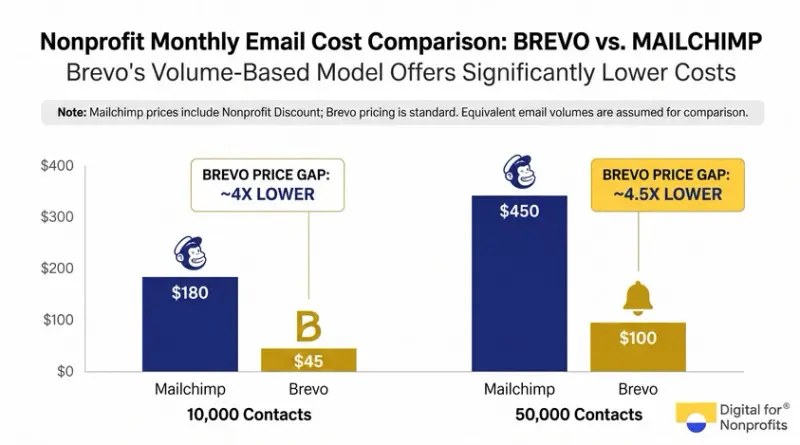
Why this matters: Brevo charges based on emails sent, not contacts stored. A nonprofit with 10,000 donors that sends one newsletter per month pays for 10,000 sends, not 10,000 stored contacts. At equivalent sending volumes, Brevo costs roughly 3 to 5 times less than Mailchimp for growing organizations.
Nonprofit discount: 15% off, primarily confirmed on Enterprise plans. Organizations should contact Brevo sales directly to verify current discount availability on Starter and Standard tiers. An additional 10% discount applies when billing annually.
Paid pricing:
Where Brevo wins: Volume-based pricing, 100,000-contact free tier, EU-native GDPR compliance, multichannel capability (email, SMS, WhatsApp, live chat), and a built-in CRM at no extra cost. In late 2025, Brevo raised €500 million and achieved unicorn status, signaling strong long-term viability.
Where it falls short: The 300 emails per day cap on the free plan makes a single mass send to a list of over 300 contacts impossible without upgrading. Fewer native integrations than Mailchimp (approximately 150 versus 300+). The nonprofit discount program is less transparent than competitors.
Best for: Nonprofits of any size evaluating tools, fresh, budget-conscious NGOs with large contact lists, international organizations needing GDPR compliance, and any organization wanting email, CRM, and SMS in one platform.
Zoho Campaigns: The Ecosystem Advantage
Zoho Campaigns is the email marketing tool within the broader Zoho suite, which includes CRM, accounting, project management, HR, and more. For nonprofits already considering Zoho, or those that want a deeply integrated system, the Zoho for Nonprofits program is among the most generous available.
Free plan: 2,000 contacts, 6,000 emails per month, up to 5 users. Includes signup forms, basic templates, and compliance checks. Automation, A/B testing, and advanced segmentation require a paid plan.
Nonprofit program: Zoho for Nonprofits provides a $5,000 wallet credit that covers 50% of every transaction across 45+ Zoho products. This means Zoho matches your spending dollar-for-dollar until the credit is exhausted, effectively giving you up to 50% off for years. Paid plans start at just $3/month for 500 contacts with unlimited emails. Credits are valid for five years and can be applied through TechSoup validation or direct document submission.
Best for: Small to mid-size nonprofits that want an integrated ecosystem (CRM, email, accounting, projects) at minimal cost. For organizations adopting Zoho broadly, the wallet credit becomes substantial.
MailerLite: The Budget-Friendly Pick With a Strong Nonprofit Discount
MailerLite is the least-discussed platform in this comparison and, for many small nonprofits, the best overall value.
Free plan: 500 subscribers (reduced from 1,000 in September 2025), 12,000 emails per month, 10 landing pages, basic automation, A/B testing, signup forms, and surveys. One user, one website. MailerLite branding on all emails; newsletter templates require a paid plan.
Nonprofit discount: 30% off any paid plan, the most consistently generous percentage discount among the platforms compared here. Apply by contacting MailerLite support with nonprofit documentation within 14 days of signing up. Renewable every 24 months. Additionally, MailerLite's Pay-it-Forward Initiative sponsors over 60 organizations globally with free two-year Advanced plans.
Paid pricing (with 30% discount):
Best for: Small to mid-size nonprofits prioritizing simplicity, affordability, and clean design. The 30% discount, combined with A/B testing and automation available even on the free plan, makes MailerLite one of the strongest entry points for growing organizations.
HubSpot: The CRM Powerhouse for Larger Nonprofits
HubSpot is not primarily an email tool. It is a full customer relationship management (CRM) platform that includes email marketing as part of its Marketing Hub. That distinction matters.
Free plan: Storage for up to 1,000,000 CRM contacts, 2,000 marketing email sends per month, landing pages and forms with HubSpot branding, and basic reporting. No automation workflows and only five email templates.
Nonprofit discount: 40% off Professional and Enterprise tiers, making it the deepest percentage discount in this comparison. Currently available to new customers in North America, Australia, and New Zealand. With the discount, Marketing Hub Professional drops from approximately $890 per month to around $534 per month. Starter-tier products are not included.
Best for: Mid-to-large nonprofits with complex donor journeys, dedicated marketing staff, and budgets that can support $500+ per month after the discount. Over 4,000 nonprofits use HubSpot, including World Wildlife Fund and The Nature Conservancy.
ActiveCampaign: Automation-First, No Free Tier
ActiveCampaign is the strongest automation platform in this comparison. Its automation builder offers 950+ pre-built recipe workflows, conditional branching, split testing within sequences, and predictive sending. It is also the only platform here with no free tier, only a 14-day trial.
Nonprofit discount: 20% off all standard plans. Apply by emailing sales@activecampaign.com with nonprofit documentation. Paid plans start at $15 per month for 1,000 contacts on annual billing.
Best for: Mid-to-large nonprofits with the budget and staff to use sophisticated multi-step donor nurture sequences, lapsed donor re-engagement workflows, and event-triggered campaigns. Not practical for organizations with limited budgets or small teams.
Mailchimp vs Brevo for NGOs: The Head-to-Head
This is the comparison most nonprofits are actually trying to answer. Here is where each platform wins.
On cost: Brevo wins decisively. At 5,000 contacts sending twice per month, Mailchimp Essentials costs roughly $75 per month. Brevo Starter covers the same volume for approximately $18 to $29 per month. At 50,000 contacts, the gap grows to $385 per month versus approximately $69 per month. That is a 5.6x cost difference driven entirely by Mailchimp's contact-based pricing model versus Brevo's email-volume model.
On the free tier: Brevo wins by a wide margin. 100,000 contacts with basic automation and a built-in CRM versus Mailchimp's 500 contacts with no automation and no scheduling.
On integrations: Mailchimp wins. 300+ native integrations versus Brevo's 150+, including deeper connections to major donation platforms.
On analytics: Mailchimp wins, particularly on Standard and Premium plans with Intuit Assist's predictive analytics, customer lifetime value scoring, and purchase likelihood modeling.
On GDPR and international compliance: Brevo wins for non-US organizations. As a France-based, B Corp-certified company, Brevo was built for EU data regulations. It supports 12+ languages and operates in 180 countries. For global NGOs, this matters.
On multichannel: Brevo wins. Email, SMS, WhatsApp, and live chat in a single platform versus Mailchimp's email-centric model with SMS as a paid add-on.
The verdict: For a nonprofit starting from zero, Brevo is the stronger choice on cost and free plan capacity. For a nonprofit already on Mailchimp with 15+ integrations and trained staff, migration costs should factor into the decision before switching.
Which Platform Fits Your Organization?
How Tech Grants Can Fund Your Email Marketing
Your nonprofit may already qualify for funding that offsets or eliminates email tool costs entirely.
Google for Nonprofits provides $10,000 per month in Google Ad Grant credits ($120,000 per year) that can drive traffic directly to your email signup pages. It also includes free Google Workspace for up to 2,000 users, meaning your team communicates via Gmail and Google Drive at no cost. In 2025, Google added 10+ AI features, including Gemini and NotebookLM, for nonprofit users. According to D4NP's research, over 83% of nonprofits globally are not claiming this grant.
Microsoft for Nonprofits offers free Microsoft 365 Business Basic licenses for up to 300 users, plus $2,000 per year in Azure cloud credits. Note that Microsoft ended free grants for Business Premium and Office 365 E1 in July 2025.
TechSoup provides access to discounts of up to 90% across 100+ technology partners, with average member savings of $17,000 per year. TechSoup also verifies nonprofit status for Google and Microsoft grant programs.
If your nonprofit has not yet activated its Google for Nonprofits account, that is the most impactful first step. The Ad Grant alone can fund a year of email marketing campaigns on any paid platform through the traffic it drives to your site. Learn how D4NP helps nonprofits activate Google for Nonprofits.
Feature Checklist: What to Verify Before You Commit
Before signing up for any platform, confirm these points:
Free plan contact limit and whether unsubscribed contacts count toward that limit
Whether automation is included in your plan tier
Whether the nonprofit discount applies to the plan level you actually need (not just Enterprise)
Whether the platform charges extra to remove its branding from your emails
GDPR and local data compliance features, especially for organizations with international supporters
Transactional email capability for donation receipts (some tools require a separate transactional email product)
Native integration with your donation platform, or Zapier availability
Your Next StepThe right email platform is the one your team will actually use, at a cost that does not strain your operating budget. For most nonprofits starting fresh in 2025, Brevo's free plan covers everything needed to build and maintain a donor communication program. For growing organizations ready to invest in automation, MailerLite's 30% nonprofit discount makes it hard to beat at the $10 to $30 per month range. And for large nonprofits with complex donor journeys, HubSpot's 40% discount brings enterprise-level capability within reach.
Before spending a dollar on email tools, make sure your nonprofit has activated its Google for Nonprofits account. The $10,000 per month in Ad Grant credits can drive the traffic your email signup pages need to grow your list, turning your email investment into a compounding return.
D4NP helps nonprofits globally activate technology grants, build digital infrastructure, and become self-reliant. If your organization is ready to build an email program that actually works, connect with our team.